Click to zoom
1 / 4
Content BlueprintNew
AI Content Blueprint
Write Health Articles That Rank on Google AND Get Cited by ChatGPT
What it is
A 14-section health content framework + 6 Quick Answer Box templates + 4 Claude Code writing skills. Produces 2,200–2,600 word health articles with 10–15 built-in AI citation opportunities per piece. $29 one-time.
$29$7963% OFF
- 14-section health article blueprint (Markdown, fill-in-the-blanks)
- 6 Quick Answer Box templates for health AI snippet extraction
- 4 Claude Code skills: blog-writer, article-writing, content-strategy, copy-editing
- Health content quality checklist (word count, schema, E-E-A-T, links)
- Free lifetime updates via Gumroad
Instant downloadWorks without Claude CodeFree updates included
The problem
Your health articles rank nowhere — and ChatGPT cites your competitor instead of you.
You researched the topic. You wrote 2,000 words on BMI, calorie deficits, or heart rate zones. You optimized your title tag. You hit publish. Three months later: page 6 on Google, zero AI citations.
Meanwhile, a thinner article from a domain with half your authority is what ChatGPT quotes when someone asks that exact health question. Perplexity cites it. Google AI Overviews feature it. You're invisible.
The gap isn't your research. It's your structure.
AI systems don't reward depth buried in long paragraphs. They cite content that is structured for extraction — direct answers placed early, FAQs that stand alone, schema that tells the crawler exactly what to quote. Health content written the old way, even excellent health content, gets passed over completely.
You need a framework engineered for both worlds simultaneously — the Google algorithm that rewards topical authority and the AI systems that demand citability. That is exactly what this blueprint delivers.
The framework
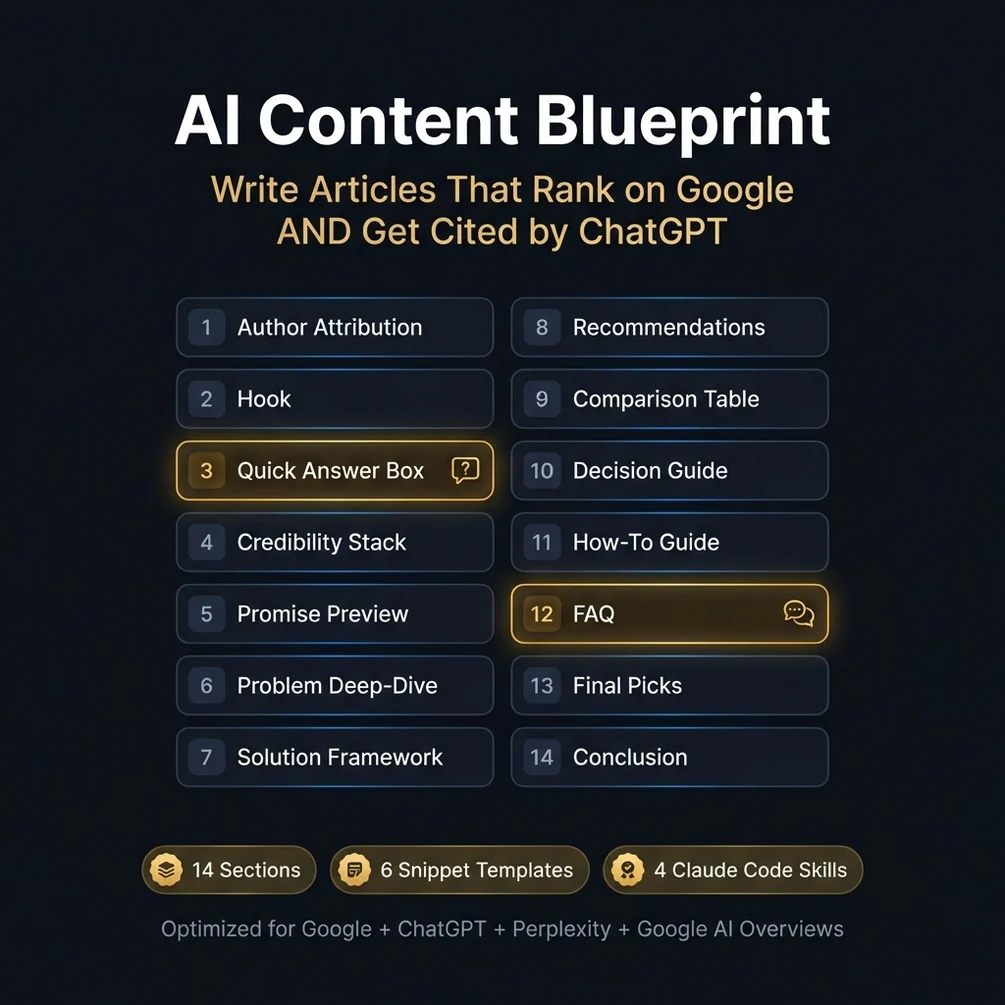
The 14-Section Health Article Blueprint
Every health article you publish follows this proven structure — section by section, word count by word count, citation signal by citation signal.
01
Author Attribution
Medical E-E-A-T signal — establishes clinical credibility with Google and AI systems
02
Hook (≤300 words)
Opens with the reader's exact health concern, creating immediate emotional resonance
03
Quick Answer Box
≤40 words of direct health guidance — the snippet ChatGPT and Perplexity quote verbatim
04
Credibility Stack
Cites studies, credentials, and data sources so both readers and AI systems trust your claims
05
Promise Preview
3–5 bullet checklist of exactly what the article answers — reduces bounce rate immediately
06
Problem Deep-Dive
Quantifies the health pain with real statistics and clinical context (250–300 words)
07
Solution Framework
Your evidence-based approach explained clearly, with mechanism and reasoning (300–400 words)
08
Recommendations
4–7 detailed health strategies or tools with 200+ words of specific guidance each
09
Comparison Table
Side-by-side breakdown of options across key health decision factors
10
Decision Guide
Who should choose what, plus the 5 most common mistakes patients and readers make
11
How-To Guide
5–7 actionable steps your reader can take today — concrete and measurable
12
FAQ (10–15 Q&As)
Each standalone Q&A is a separate AI citation opportunity targeting long-tail health queries
13
Final Recommendations
Best Overall / Best for Beginners / Best for Medical Conditions — clear verdict
14
Conclusion & Next Steps
Recap + next action + freshness signal to trigger Google re-crawl
Sections 3 and 12 are the AI citation engines. Section 3 (Quick Answer Box) is ≤40 words — the direct health fact AI systems quote first. Section 12 (FAQ) gives you 10–15 separate citation opportunities inside a single health article.
The formula
The AI Citation Formula for Health Content
Most health publishers don't know why ChatGPT cites some articles and skips others. Here's the exact formula — built into every section of the blueprint.
1Section 3
Quick Answer Box
A direct health fact stated in ≤40 words at the top of the article. AI systems extract this as the featured snippet.
2Section 12
FAQ Section
Each health Q&A is a standalone citation opportunity. 15 FAQs = 15 chances to appear in AI-generated answers.
3Credibility
Specific Clinical Numbers
"A BMI above 30 increases cardiovascular risk by 28%" gets cited. "A high BMI is bad for your heart" does not.
4Technical
Schema Markup
FAQPage + MedicalWebPage JSON-LD tells AI systems your health content is structured, authoritative, and trustworthy.
5AEO
SpeakableSpecification
Marks your Quick Answer Box as the preferred citation excerpt for AI search engines processing health queries.
Claude Code automation
4 Health Writing Skills Included
Already using Claude Code? These skills automate the entire health content pipeline. Don't use Claude Code? The templates and blueprint work completely standalone.
/blog-writerGenerates complete SEO + GEO-optimized health blog posts following the 14-section blueprint in a single command
/article-writingWrites long-form health guides, condition explainers, and nutrition deep-dives in your brand voice
/content-strategyMaps health keyword clusters, identifies high-intent calculator queries, and builds a 90-day content calendar
/copy-editingReviews health drafts for medical accuracy signals, readability, and AI citability — flags weak sections instantly
Don't use Claude Code? No problem — the 14-section health blueprint and Quick Answer Box templates work as standalone Markdown files in any writing tool, CMS, or word processor.
Built-in standards
Medical-Grade Content Standards, Automatically
Word Count
2,200–2,600 words
Depth sweet spot for health YMYL rankings
Paragraph Length
2–3 sentences max
Mobile-first health reader behavior
Internal Links
Minimum 15/article
Links to calculators, condition pages, tools
External Citations
3+ clinical sources
PubMed, NIH, peer-reviewed journals preferred
Headings
Question-first H2/H3
"Which BMI Range Is Dangerous?" not "BMI Overview"
Voice
American English, "you"-focused
Specific numbers over vague health claims, always
Who it's for
Built for Serious Health Content Publishers
Health Content Writers
Publishing 2+ health articles per week who need every piece to rank on Google AND show up when someone asks ChatGPT.
Wellness SEO Specialists
Who know Google rankings alone are losing ground — 43% of health searches now return AI-generated answers instead of links.
Health Platform Teams
Who need a repeatable content system that scales across dozens of conditions, calculators, and symptom guides.
Medical Affiliate Publishers
Writing supplement, device, and health product reviews — this Wirecutter-style framework is what converts health-anxious readers.
FAQ
Common Questions
Do I need Claude Code to use this AI Content Blueprint?
No. The 14-section health content blueprint and Quick Answer Box templates are Markdown files that work with any writing tool — Word, Notion, Google Docs, or any CMS. The 4 Claude Code skills are optional add-ons for teams that want to automate article production.
How long does it take to write a health article using this framework?
Writing a well-researched 2,400-word health article manually using the blueprint takes 2–3 hours. Using the included Claude Code /blog-writer skill, you can produce a full draft in 15–20 minutes that you then refine for medical accuracy and brand voice.
What makes the Quick Answer Box different from a standard introduction?
The Quick Answer Box is placed early in the health article, capped at 40 words, written as a direct factual health statement, and marked with SpeakableSpecification schema — the exact format ChatGPT, Perplexity, and Google AI Overviews prefer to extract and cite verbatim.
Will this framework work for any health niche?
Yes. The AI Content Blueprint is topic-agnostic within health. It works for fitness, nutrition, mental health, chronic conditions, weight management, supplements, medical devices, and any health topic where Google ranking and AI citation authority matter.
How is this different from generic health content AI generators?
Generic AI prompts produce flat, unstructured health content that fails E-E-A-T and Helpful Content checks. This blueprint provides section-by-section architecture with word counts, citation formulas, credibility signals, and schema baked in — structure AI generators cannot replicate.
Does the framework include guidance on internal linking for health sites?
Yes. The blueprint enforces a minimum of 15 internal links per article, woven naturally throughout the content, with specific guidance on linking health calculators, condition pages, and related tools — directly strengthening topical authority across your health domain.
What is included in the AI Content Blueprint download?
The download includes: the 14-section health article blueprint in Markdown, 6 Quick Answer Box templates optimized for health queries, 4 Claude Code skills (blog-writer, article-writing, content-strategy, copy-editing), a health content quality checklist, and free lifetime updates via Gumroad.
Is the 2,200–2,600 word target right for health content?
That word range is the proven sweet spot for health articles that rank and demonstrate depth. Shorter health content fails to cover mechanisms, risks, and FAQs adequately. Longer content risks padding that Google's Helpful Content system penalizes. The 14 sections fill this range naturally.
Structure is the difference
Health content that exists vs health content that gets cited.
14 sections. 10–15 AI citation opportunities per article. Works standalone or with Claude Code. One payment, unlimited health articles, free updates forever.
Get the Blueprint — $29Instant download · Free lifetime updates · Works with any writing tool