Click to zoom
1 / 4
Schema Templates6 JSON-LD Files2 SkillsBest Entry Point
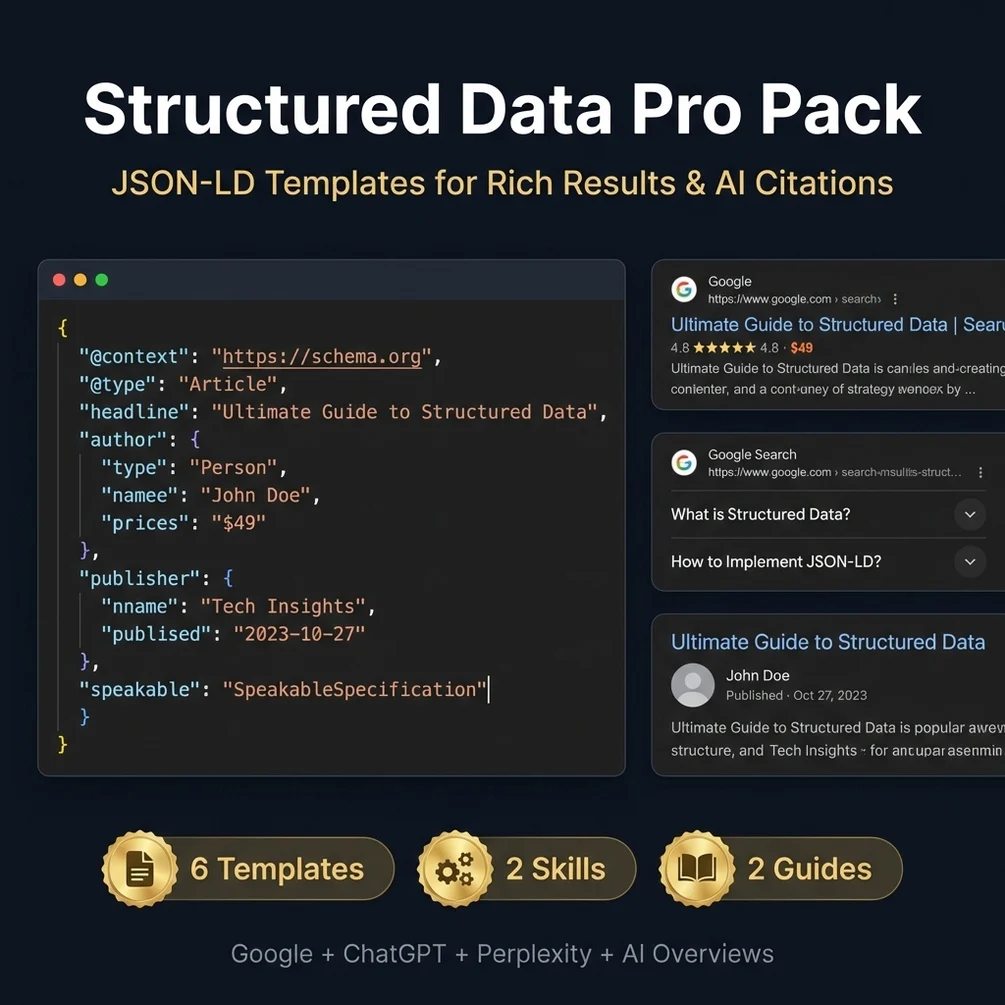
Structured Data Pro PackJSON-LD Schema for Rich Results & AI Citations
4.8 / 5 (94 reviews)
$19
One-time purchaseNo subscription
What's Included
- 6 JSON-LD schema templates (copy, customize, deploy)
- article-author.json — E-E-A-T author entity for health content
- local-business.json — Google Maps + local citation signals
- organization.json — brand entity markup
- product-ecommerce.json — price, reviews, stock availability
- software-saas.json — health tools and calculator rich results
- website-searchaction.json — sitewide search box in Google
- 2 Claude Code skills (/schema-markup + /geo-schema)
- Schema Types Guide + Implementation Patterns reference
- Free lifetime updates
Instant Download
Lifetime Access
Free Updates
Requirements
- Templates work without any software — open and edit
- Claude Code for automated /schema-markup and /geo-schema workflows (optional)
- Works on Windows, macOS, Linux
- Any CMS or static site
Competitors Have Stars in Google. You Have a Plain Link. That's a Schema Problem.
You spent 40 hours building the best BMI calculator on the internet. You wrote the definitive guide on macronutrients. You published in-depth calorie breakdowns that took days to research. And when someone Googles the exact question you answered? Your competitor's result shows star ratings, FAQ dropdowns, and a rich snippet. Yours is a plain blue link.
It gets worse. When someone asks ChatGPT or Perplexity what you've already written about — optimal protein intake, TDEE formulas, healthy BMI ranges — they cite someone else. Not because their content is better. Because they have structured data and you don't.
JSON-LD schema markup tells Google and AI systems exactly what your content is — the author, the topic, the question and answer, the product price, the business hours. Without schema, every crawler on the internet is guessing what your page means. They guess wrong, consistently. With schema, they know — and they reward that knowledge with rich results and AI citations.
Health sites with proper schema are 2.7× more likely to earn Google rich results. FAQPage schema turns your Q&A sections into direct citation targets for ChatGPT and Perplexity. And the SpeakableSpecification property — which marks your best paragraph as the preferred AI excerpt — is implemented by fewer than 5% of health sites. That gap is your opportunity.
Without Schema
- ✕Plain blue link — zero rich results
- ✕Google guesses what your health content means
- ✕ChatGPT cites your competitors instead of you
- ✕No author entity — weak E-E-A-T for medical content
- ✕Product listings show no price or review stars
With Schema
- Star ratings, FAQ dropdowns, author bylines in SERP
- Google and AI know exactly what you publish
- SpeakableSpecification controls the AI quote
- Author entity builds medical E-E-A-T authority
- Price, availability, and reviews displayed in results
Copy · Customize · Deploy
6 JSON-LD Templates, Zero Guesswork
Production-ready files for every health site type. Replace placeholders, paste into your page head — done in 5 minutes.
article-author.jsonArticle + Author
Use when: Blog posts, health guides, research articles
Rich result: Author photo, publish date, article type in search
AI citation: Person entity for E-E-A-T + SpeakableSpecification
local-business.jsonLocal Business
Use when: Clinics, gyms, wellness centers, local services
Rich result: Google Maps panel, hours, phone number, star ratings
AI citation: Location entity for local AI search citations
organization.jsonOrganization
Use when: Brand entity markup on homepage or About page
Rich result: Knowledge panel, sitelinks, brand recognition
AI citation: Brand entity recognition + sameAs links
product-ecommerce.jsonProduct (E-commerce)
Use when: Health product pages with pricing and reviews
Rich result: Price, stock status, star ratings in search results
AI citation: Product entity + Offer + AggregateRating
software-saas.jsonSaaS / Software
Use when: Health tools, calculators, wellness apps
Rich result: Software-specific rich results, pricing, features
AI citation: SoftwareApplication entity with requirements
website-searchaction.jsonWebSite + SearchAction
Use when: Any health site wanting a sitewide search box in Google
Rich result: Search box displayed directly in Google SERP
AI citation: Site entity + potentialAction for AI navigation
The 5% Advantage
The 3 Schema Properties That Drive AI Citations
Standard schema earns you rich results. These three properties earn you citations in ChatGPT, Perplexity, and Google AI Overviews — and fewer than 5% of health sites have implemented them.
SpeakableSpecificationPinpoints the exact page section AI systems should quote. When ChatGPT needs a 2-sentence answer from your health guide, SpeakableSpecification is where it looks first — so you control the excerpt, not the algorithm.
"speakable": { "@type": "SpeakableSpecification", "cssSelector": ".quick-answer" }citationBroadcasts provenance signals. Tells AI systems your content references authoritative medical and scientific sources — directly increasing your credibility score and citation probability in AI responses.
"citation": [{ "@type": "CreativeWork", "name": "Source Title", "url": "..." }]mentionsBuilds knowledge graph connections. Links your content to specific health topics, conditions, and organizations so AI systems understand your site's authority domain and surface you for relevant queries.
"mentions": [{ "@type": "Thing", "name": "Topic Name" }]Claude Code Skills
2 Skills That Generate Schema From Any URL in 2 Minutes
Use the 6 templates manually in 5 minutes — or point either skill at a live URL for fully automated schema generation.
/schema-markup"I don't know what schema my health site needs"
- Fetches and audits your live page
- Detects existing schema and surfaces errors
- Identifies every missing recommended type
- Generates ready-to-paste JSON-LD blocks
- Includes all 3 AI citation properties
$ /schema-markup https://yourpage.com
/geo-schema"I want AI systems to actively cite my health content"
- GEO-optimized schema built for AI citation
- Injects SpeakableSpecification on key sections
- Wires in citation + mentions properties
- Optimizes entity relationships for authority
- Sends knowledge graph connection signals
$ /geo-schema https://yourpage.com
Full Coverage
Every Major Schema Type, Covered
The skills and reference guide cover all schema types relevant to modern health and wellness SEO.
Content
ArticleFAQPageHowToBreadcrumbList
Business
OrganizationLocalBusinessService
Products
ProductOfferAggregateRating
Software
SoftwareApplicationWebSiteSearchAction
People
Person (author entity for E-E-A-T)
Who This Pack Is For
Health Site Owners
Your competitor's BMI calculator shows star ratings and FAQ dropdowns in Google. Yours gets a plain link. One JSON-LD file closes that gap.
SEO Professionals
Stop hand-crafting JSON-LD for every client from scratch. 6 reusable templates and a skill that generates schema from any live URL in 2 minutes.
Health Content Creators
You've written the definitive guide on macro tracking. Turn it into a direct AI citation target with FAQPage + SpeakableSpecification markup.
Supplement & Product Shops
Shoppers searching for your product see zero pricing or reviews in Google. Product schema fixes that and gets your star ratings into the SERP.
Clinics & Wellness Centers
Patients search for a physiotherapist near them and your competitor's hours, phone, and reviews appear in the map pack. Yours doesn't. LocalBusiness schema.
Digital Health Agencies
Deploy accurate, AI-ready schema across an entire health client roster. One template set, unlimited sites, no per-client license fees.
Frequently Asked Questions
What is included in the Structured Data Pro Pack?
The Structured Data Pro Pack contains 6 production-ready JSON-LD schema templates (Article+Author, LocalBusiness, Organization, Product+Ecommerce, SaaS/Software, WebSite+SearchAction), 2 Claude Code skills (/schema-markup for automated detection and generation, /geo-schema for AI citation optimization), and 2 reference guides. Every template pre-loads AI citation properties — SpeakableSpecification, citation, and mentions — that standard schema generators omit entirely.
What is SpeakableSpecification and why does it matter for AI citations?
SpeakableSpecification is a schema.org property that flags specific page sections as the preferred content for AI systems to extract and quote. When ChatGPT or Perplexity needs a concise answer, SpeakableSpecification tells them exactly where to look. Without it, AI systems guess — and usually cite someone else. With it, you control the exact paragraph that gets quoted in AI responses.
What does the /schema-markup Claude Code skill do?
Run /schema-markup followed by your page URL and the skill fetches your live page, audits any existing schema for errors, identifies every missing recommended schema type, and generates ready-to-paste JSON-LD code blocks — including AI citation properties like SpeakableSpecification. The entire process takes under 2 minutes. Copy the output and paste it into your page head.
How is this different from free schema generator tools?
Free schema generators produce bare-minimum output filled with placeholder data. They skip SpeakableSpecification, citation, and mentions — the properties that drive AI citations. They don't audit what you already have, don't surface existing errors, and don't flag missing schema types. The Structured Data Pro Pack delivers production-ready templates built for the AI search era, plus 2 skills that automate the full process in 2 minutes.
How quickly do rich results appear after adding schema?
Google typically processes new schema markup within days to two weeks, depending on your site's crawl frequency. Validate your implementation immediately at schema.org/validator and Google's Rich Results Test. Once Googlebot crawls and confirms valid markup, rich results — star ratings, FAQ dropdowns, breadcrumbs, product pricing — appear in search results without further action.
Do I need Claude Code to use the JSON-LD templates?
No. All 6 JSON-LD templates work entirely without Claude Code. Open the template file, swap the placeholder values with your real data, paste the completed JSON inside a script tag in your page head, and validate at schema.org/validator. The 2 Claude Code skills are optional power tools that automate detection, error-finding, and generation from a live URL — useful but not required.
Which schema template should I use for my site?
Use article-author.json for blog posts, guides, and news content. Use local-business.json for physical locations needing Google Maps integration. Use organization.json for company-level brand entity markup on your homepage or About page. Use product-ecommerce.json for product pages with pricing and reviews. Use software-saas.json for SaaS tools and apps. Use website-searchaction.json for any site that wants a search box in Google results. The included reference guide has a full decision tree.
What do the 'citation' and 'mentions' schema properties do?
The citation property adds provenance signals — it tells AI systems your content references credible sources, raising trustworthiness and citation probability. The mentions property builds entity associations by connecting your content to specific topics, people, and organizations in the knowledge graph. Together with SpeakableSpecification, these 3 properties move AI behavior from 'can read your page' to 'actively cites your page.'
Can I use these templates across multiple client sites?
Yes. One purchase covers unlimited use across all client sites with no per-site or per-client restrictions. The templates are built to be reusable — customize placeholder values per client and deploy. The /schema-markup skill can run on any client URL as many times as needed. Agencies consistently report deploying correct schema across an entire health client roster in under a day.
One-Time Purchase
Rich Results & AI Citations for $19
6 JSON-LD templates + 2 Claude Code skills. Deploy your first health schema in 5 minutes flat. One purchase, unlimited sites, no recurring fees — ever.
Get Instant Access — $19Secure checkout via Gumroad · Instant digital delivery